Sources of Space Weather
Unlike the water cycle of tropospheric weather, space weather is driven from the outside. Most sources of space weather change with solar activity, the 11-year rise and fall of sunspots on the Sun. Space Weather can cause changes in the space environment through events such as solar flares and Coronal Mass Ejections (CMEs) that occur on timescales of minutes to days or solar-cycle effects that occurs on timescales of 11-years or more.
The Solar Cycle
The 11-year sunspot or solar cycle is a rhythmic waxing and waning of the number of dark sunspots on the visible disk of the Sun. It comes from the "winding-up" of the solar magnetic field during which the magnetic field gradually decays and then finally undergoes a total magnetic reversal, which is when the magnetic poles flip. As the magnetic field becomes gradually
more entwined towards solar maximum the surface fields of the Sun becomes more and more wrapped up. This increases the activity on the surface of the Sun, seen as sunspots (regions of highly complex and intense magnetic fields) and the more frequent occurrence of solar flares and coronal mass ejections.
The Sun is brighter at EUV and X-ray wavelengths during solar maximum then at solar minimum. This global brightening has Space Weather consequences. Impulsive events, such as coronal mass ejections, solar flares, or
high speed streams in the solar wind, occur on timescales of minutes to hours, or even days. Delayed sources of space weather, such as geomagnetic storms, start after the solar signal that triggers the storm has passed the Earth and can last for days to weeks. Galactic cosmic rays are reduced by solar activity and have more rapid variations caused by CMEs. Interplanetary dust particles are a continuous source of easily-ionized meteoric material to the Earth. Impacts of asteroids and comets are infrequent, catastrophic events.
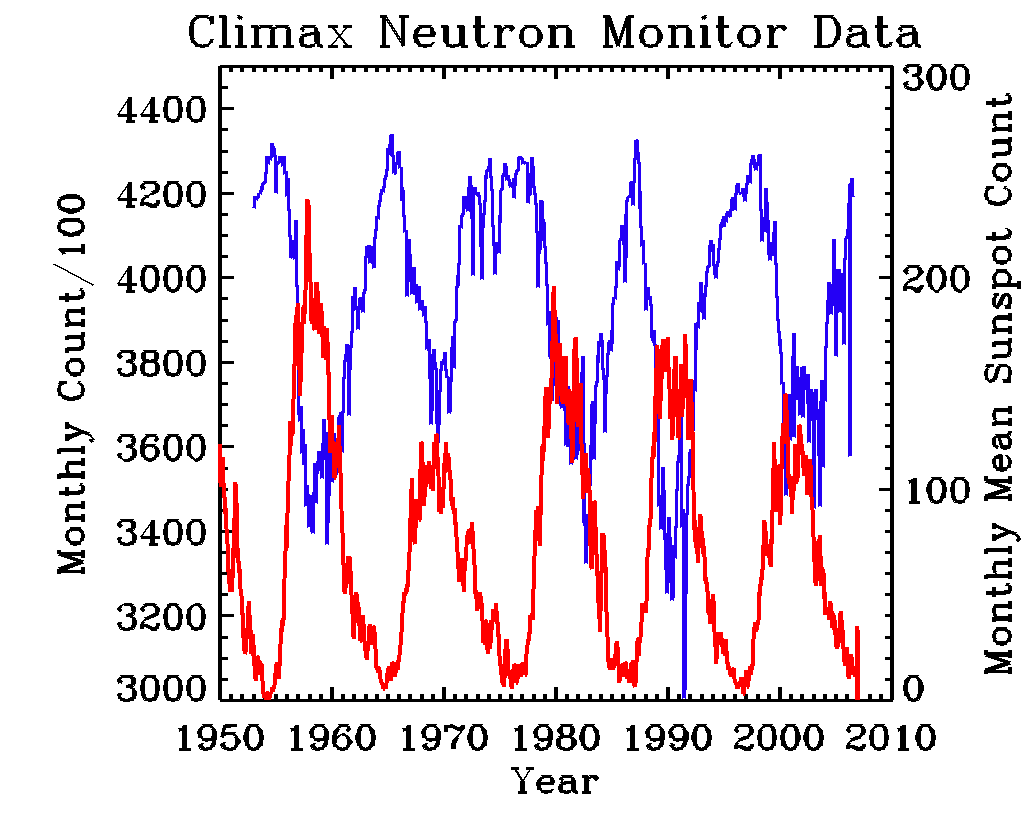
Our Sun's 11-year cycle of activity varies the amount of incoming Galactic Cosmic Radiation received here on Earth.
Coronal Mass Ejections
A Coronal Mass Ejection (CME) occurs when a prominence suspended above the surface of the Sun erupts and sends millions of tons of material into space. This cloud of charged particles is generally confined within a magnetic field (like a magnetic bubble), expanding and traveling out through the solar system at speeds from about 200 km/s up to a staggering 2000 km/s. When directed towards Earth a CME typically arrives 2-3 days after eruption but in exceptional cases can arrive in less than 24 hours. The ensuing activity in the local space environment can wreak havoc with technologies at Earth; from satellite failures to city-wide electrical black-outs. CMEs are spectacular events to watch, inset is an image of an event captured by the LASCO coronagraph on the SOHO satellite.
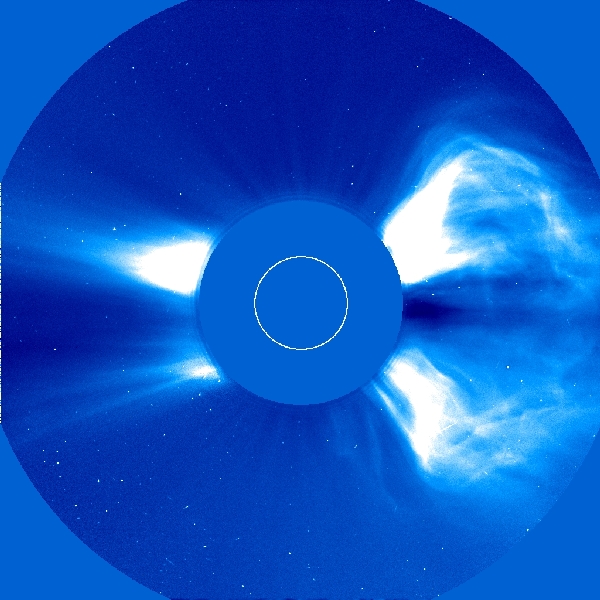
Large coronal mass ejection (CME) at 12:36 UT on 6 November 1997 as recorded by the LASCO C2 coronagraph on SOHO.
Solar Flares
A solar flare is a bright flash of X-rays seen during an energetic explosion in an active region of the Sun. It's usually seen as a large burst of X-rays, but may also have a coincident bright flash of white light. A flare lasts a matter of minutes but releases an immense amount of energy. During solar flares the Sun can be 1000 times brighter in X-rays than normal. Flare intensities are categorized by National Oceanic and Atmospheric Association's Space Weather Prediction Center (NOAA SWPC) based on the X-ray flux measured at Earth. Large X-ray flares can cause greatly enhanced levels of ionization of the Earth's ionosphere that can cause problems for radio communications as well as certain types of low-frequency navigation.
Solar Energetic Particle (SEP) Events
In some cases solar flares and CMEs can generate high fluxes of extremely high energy particles called Solar Energetic Particles (SEPs). These charged particles consist mainly of protons and electrons. They are thought to be accelerated either by solar flares above the surface of the Sun or by their interaction with CMEs as the particles travel through the solar system.
The energy of these particles ranges from a few MeV (a velocity 4.6% of the speed of light) to well over a 1 GeV (1000 MeV, or a velocity 87% of the speed of light). During an SEP event the most energetic particles arrive at Earth in only 15 to 30 minutes with the less energetic particles (10-100 MeV) arriving hours to days later. However, the most energetic particles usually subside more quickly too, remaining at elevated levels for only a few hours after the onset of an event. Particles with lower energies can remain at highly elevated fluxes for days after the event.
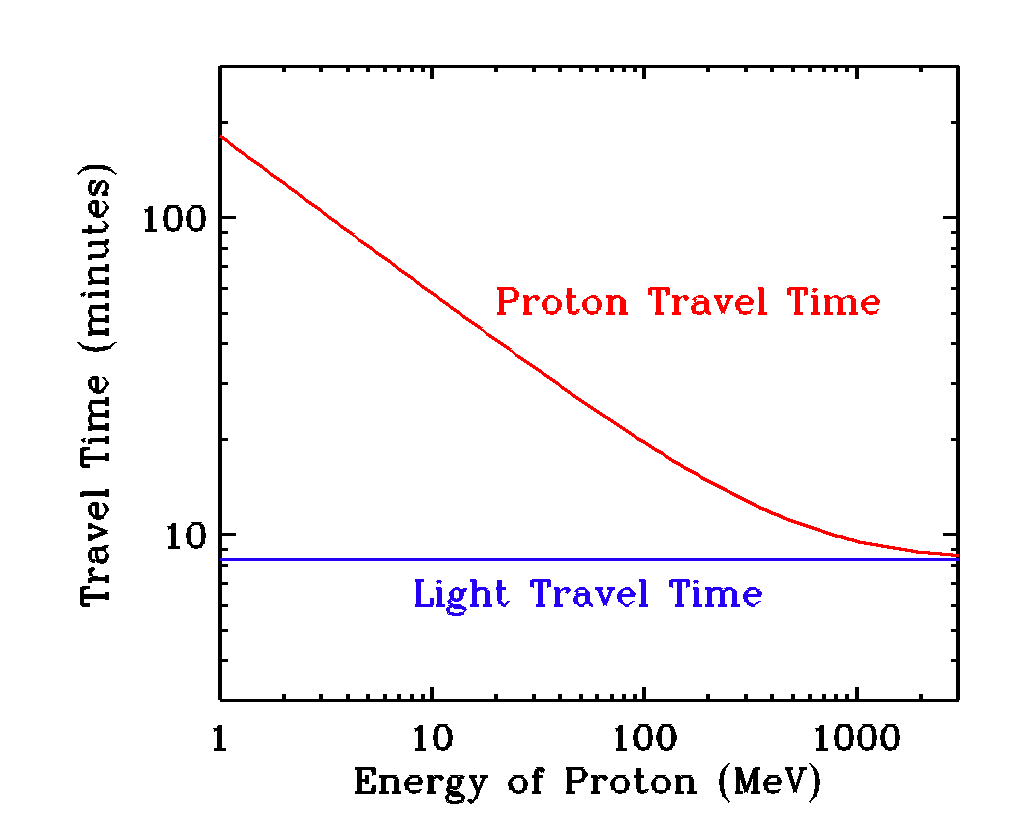
Travel times for protons leaving the Sun and moving in a straight line to the Earth. Light takes 8 1/2 minutes to travel from the Sun to the Earth. Protons with large energy can arrive almost as fast, but with lower energy the protons take much longer.
High Speed Streams in the Solar Wind
A high speed stream (HSS) is like a powerful gust in the solar wind. Near the edge of a HSS are regions of high particle density and strong magnetic fields while inside the stream the density and field are low and the temperature and velocity are high. The flow velocity inside a HSS can reach 300 to 1000 km/s. In some cases they will produce interplanetary shocks. High speed streams come from coronal holes, dark regions in the solar corona, and are most common during the declining phase of the solar cycle. High-speed streams can last a long time and we often see a HSS every 27 days as its home coronal hole rotates into the right position. Because coronal holes do not align with sunspots or active regions and could only be seen once coronal images from space were available, the origin of high speed streams was originally assigned to M-regions.
Geomagnetic Storms
The Earth's magnetosphere is a bubble created around us by our magnetic field that protects us from most of the particles the Sun throws at us. When a CME or high speed stream arrives at Earth it buffets the magnetosphere. If the arriving solar magnetic field is directed southward it interacts strongly with the oppositely oriented magnetic field of the Earth. The effect is the Earth's magnetic field is peeled open like an onion allowing energetic solar wind particles to stream down the field lines to hit the atmosphere over the poles. At the Earth's surface a magnetic storm is seen as an rapid drop in the Earth's magnetic field strength (typically a drop of 30 to 500 nT in 1-2 hours). This decrease lasts about 6 to 12 hours, after which the magnetic field gradually recovers over a period of several days.
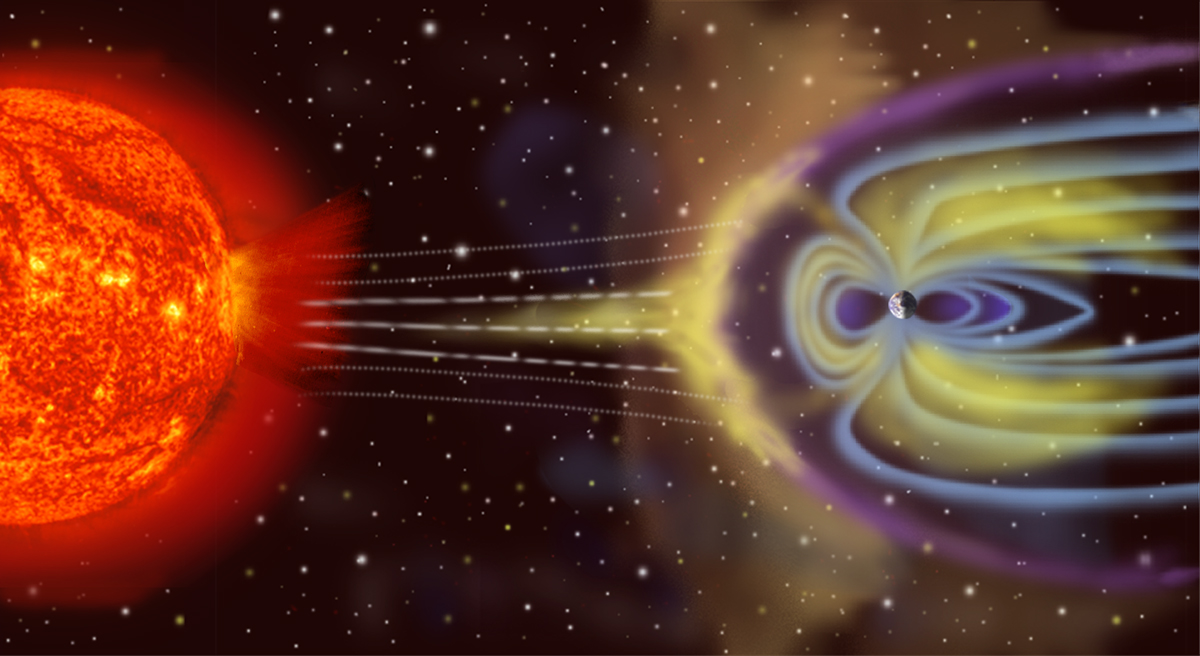
Geomagnetic storms are formed when a CMEs or high speed solar wind stream strikes the magnetosphere.
Galactic Cosmic Rays
A constant rain of Galactic Cosmic Rays (GCRs) passes through all of space. These charged particles are accelerated to extremely high energies by galactic events such as supernovae (the catastrophic collapse of a star) although some may come from outside the Milky Way. Their high energy allows GCRs to penetrate through the Earth's magnetosphere and deep into the atmosphere. As they enter the atmosphere they collide with molecules of oxygen and nitrogen and produce millions of tiny fragments. The GCR ionization rate (roughly the radiation dose) reaches a maximum at an altitude of about 12 km (40,000 ft) and then decreases towards the Earth's surface.
The intensity of the Galactic Cosmic Rays (GCR) at Earth is highest during solar minimum. This happens because the intense regions of magnetic field extending out from the Sun into the solar system during solar maximum divert the charged cosmic rays away from the solar system. As a result the GCR intensity at Earth during solar maximum is half the GCR intensity during solar minimum.
Interplanetary Dust Particles and Meteoroids
Ablation products from Interplanetary Dust Particles and Meteoroids (IDPs) create sporadic E on the Earth and long-lived ion layers on other planets. These layers can affect communications. The less compressed layers of meteoric ions may cause noctilucent clouds. There is also a danger of an impact on a satellite while in orbit. Orbital debris, small particles left in orbit by satellites, is one of the biggest hazards to satellites orbiting in low-Earth orbit (altitudes below 1000 km, which is below the radiation belts.) This includes the International Space Station.
Asteroids and Comets
Impacts of the larger minor bodies (asteroids and comets) are catastrophic events. Although the IDPs are a continuous source of meteoric material to the Earth, the larger impacts provide a similar annual mass flux. Thankfully that mass flux enters over millions of years—not everyday. A sufficiently large asteroid or comet can strip the Earth of its atmosphere. Although asteroids and comets are a source of space weather, they are too rare to discuss below.